MoU Signed Between Jindal Stainless and MIT World Peace University Special Course on Tunnel Engineering Launched at MIT
Students to Gain Practical Knowledge on Stainless Steel Usage, Corrosion Resistance, and Sustainable Construction
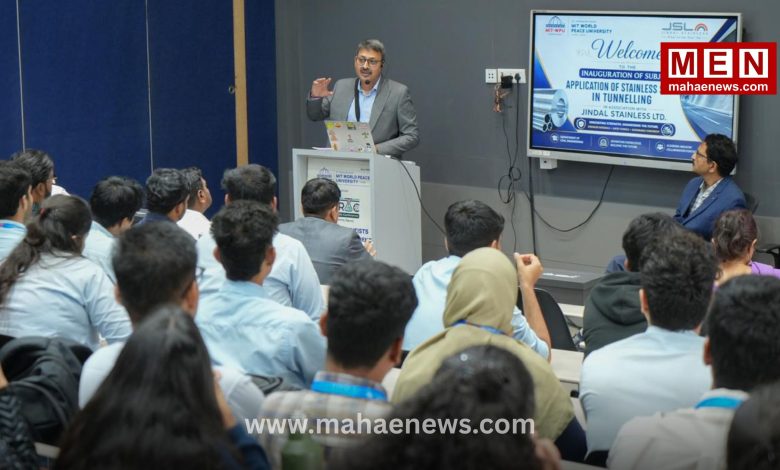
Pune | Recognizing the growing need for underground infrastructure, Jindal Stainless and Pune’s MIT World Peace University (MIT-WPU) have signed a Memorandum of Understanding (MoU) to launch a specialized course on tunnel engineering. The course is titled ‘Stainless Steel: A Sustainable, Green, and Innovative Material for Tunnel and Underground Construction.’
Follow MahaENews-X on: Follow MahaENews on Instagram
Through this course, students will acquire practical knowledge regarding the use of stainless steel in tunnel construction, its corrosion resistance, selection of the appropriate grade, design, welding, and fabrication, as well as the material’s life-cycle cost and sustainability aspects. The first batch of the course commenced on August 10, with 25 students currently enrolled.
Large-scale projects involving metro rail, highways, railways, hydropower, and pumped storage are underway across the country. Many of these projects require the construction of tunnels and other underground structures. These structures must remain durable over the long term, even when exposed to groundwater, humidity, and corrosive environments. Consequently, there is an increasing demand for engineers skilled in the proper application of durable and corrosion-resistant materials.
Against this backdrop, the course has been launched to foster collaboration between the industry and academia. The MoU is valid for a period of three years. Both institutions will work jointly on the development, teaching, and periodic updating of the course curriculum.
Tarun Khulbe (CEO, Jindal Stainless), Madhur Gupta (Business Unit Head, Jindal Stainless Steelway Limited), and Sandeep Singh (Head – Strategic Business & Tunnel Infra) signed the agreement on behalf of the company. Signatories from MIT-WPU included Dr. Siddharth Chakraborty, Dean of the Faculty of Engineering and Technology; Dr. Shantini A. Bokil, Professor in the Civil Engineering Department and Program Director; Dr. Sandeep Potnis, Director of the Centre of Excellence for Tunnelling and Underground Construction and Head of the Tunnel Engineering Program; and Dr. Abhaysinha G. Shelake, Assistant Professor and Academic Coordinator.
Tarun Khulbe, CEO of Jindal Stainless, said, “It is essential to groom competent engineers for the future of India’s infrastructure. Collaboration between industry and academia connects students to real-world work and provides them with up-to-date knowledge of the relevant industry. This partnership with MIT-WPU is a significant step in that direction. We aim to create a skilled workforce for the country’s infrastructure sector through practical and application-based education.”
Deepak Agarwal, Head of Jindal Stainless’s Jajpur unit in Odisha, said, “Underground infrastructure and tunnel projects are expanding in India. Consequently, future engineers need to be knowledgeable about advanced and sustainable materials. This course will offer students the opportunity to understand the practical application of stainless steel in tunnel engineering. Guidance from industry experts and hands-on experience will enable students to develop the skills necessary to build durable and innovative infrastructure.”
For this course, Jindal Stainless will provide expert lectures, practical sessions, study materials, and real-world industry exposure. Students will have opportunities for company site visits, internships, case studies based on actual projects, research projects, and interactions with industry experts.
The course will comprise a total of 40 lectures and eight practical sessions. The curriculum includes case studies, industry interactions, site visits, and project-based learning. Six faculty members and industry experts will mentor the students.
Tunnel projects worth over ₹5 lakh crore are expected in the country over the coming decade. Consequently, the use of corrosion-resistant and durable materials—such as stainless steel—will be crucial for the
long-term durability of underground infrastructure.
Dr. Sandeep Potnis, Head of the Tunnel Engineering Program at MIT-WPU, said, “Underground infrastructure is expanding rapidly in India. This has created a growing need for engineers knowledgeable in advanced materials and designs based on circular economy principles. This partnership with Jindal Stainless will provide students with practical industry experience alongside their academic learning. Through expert guidance, hands-on training, and research, students can be prepared for actual tunneling and underground construction projects.”
Meanwhile, a team of four faculty members from MIT-WPU, led by Dr. Sandeep Potnis, recently visited Jindal Stainless’s plant in Jajpur. During the visit, the faculty gained insights into stainless steel production, metallurgy, alloy manufacturing, automation, quality control, and corrosion-resistant applications. This experience will be utilized to explain real-world industry examples to the students.
This collaboration between Jindal Stainless and MIT-WPU will help strengthen the link between industry and academia. Furthermore, it will support the country’s expanding underground infrastructure sector.