
Supreme Court Stays Madras High Court Order on Complete Ban on Cattle Slaughter in Tamil Nadu
Top court grants interim relief to the Tamil Nadu government, saying the High Court's blanket ban will remain on hold until further orders.
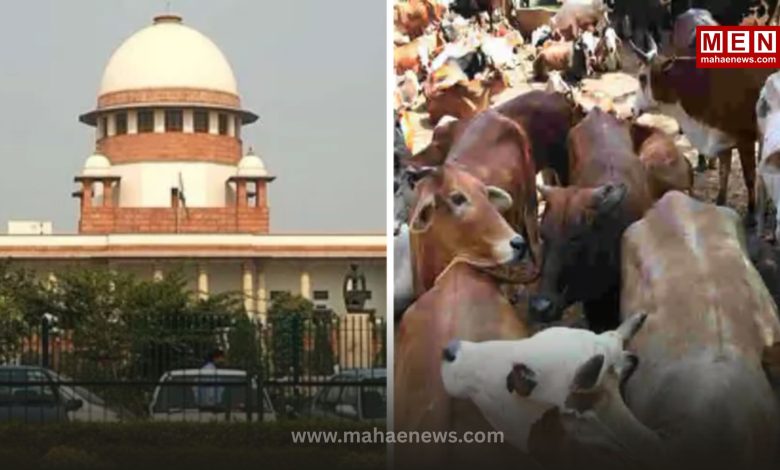
New Delhi: The Supreme Court of India has stayed the Madras High Court’s order imposing a complete ban on cattle slaughter in Tamil Nadu, granting interim relief to the state government. The apex court observed the matter while hearing the Tamil Nadu government’s appeal against the High Court’s ruling.
Follow MahaENews-X on: Follow MahaENews on Instagram
A Bench comprising Justice Vikram Nath and Justice Sandeep Mehta suspended the High Court’s May 27 order until further directions and issued notices to the respondents in the case.
Why Did the Tamil Nadu Government Challenge the Order?
The Tamil Nadu government approached the Supreme Court on June 9, arguing that the High Court had exceeded its jurisdiction by directing a blanket prohibition on cattle slaughter, including in authorised slaughterhouses.
Representing the state, senior counsel Jayashree Narasimhan argued that the original public interest litigation (PIL) was limited to preventing illegal or public slaughter of cattle during Bakrid (Eid al-Adha). However, the High Court expanded the scope of the case and ordered a statewide ban on cattle slaughter, which the government said was beyond the issues raised in the petition.
Government’s Legal Stand
The state contended that the High Court’s direction conflicts with the Tamil Nadu Animal Preservation Act, 1958, which permits the slaughter of cattle under specific conditions. Under the Act, cattle over the prescribed age and declared unfit for breeding or agricultural work may be slaughtered with the approval of competent authorities.
The government also argued that laws such as the Prevention of Cruelty to Animals Act, 1960, and the Tamil Nadu Urban Local Bodies Rules, 2023, regulate slaughter through prescribed conditions rather than imposing a complete prohibition.
According to the state, the High Court’s order effectively amounted to judicial law-making by creating restrictions that were not contemplated under existing legislation.
The government further assured the court that illegal slaughter in public places is already prohibited and that religious animal sacrifice is permitted only in accordance with applicable laws and regulations.
What Was the Original Case?
The dispute originated from a PIL filed by K. Surya Prashanth, a resident of Coimbatore, who alleged that preparations were being made for illegal cattle slaughter at unauthorised locations during Bakrid. Claiming that authorities failed to act despite complaints, he sought judicial intervention.
While hearing the petition, the Madras High Court referred to Article 48 of the Constitution of India, a Directive Principle that calls upon the State to take steps for preserving and improving animal husbandry and prohibiting the slaughter of cows, calves, and other milch and draught cattle.
The High Court also referred to historical and constitutional perspectives on cow protection and cited earlier Supreme Court judgments while observing that cow slaughter is not an essential religious practice in Islam.
What Does the Supreme Court’s Stay Mean?
With the Supreme Court staying the Madras High Court’s order, Tamil Nadu’s existing legal framework governing cattle slaughter remains in force. This means slaughter may continue only in accordance with the provisions of the Tamil Nadu Animal Preservation Act, 1958, and other applicable laws until the Supreme Court delivers its final decision.
The matter will now be heard further before the Supreme Court.
Follow MahaENews-X on: Follow MahaENews on Instagram