To the Point: The Moshi Garbage Depot Tragedy and the Ignorance of Political Leaders!
A barrage of allegations without fact-checking; has a race begun to capitalize politically on this unfortunate tragedy?
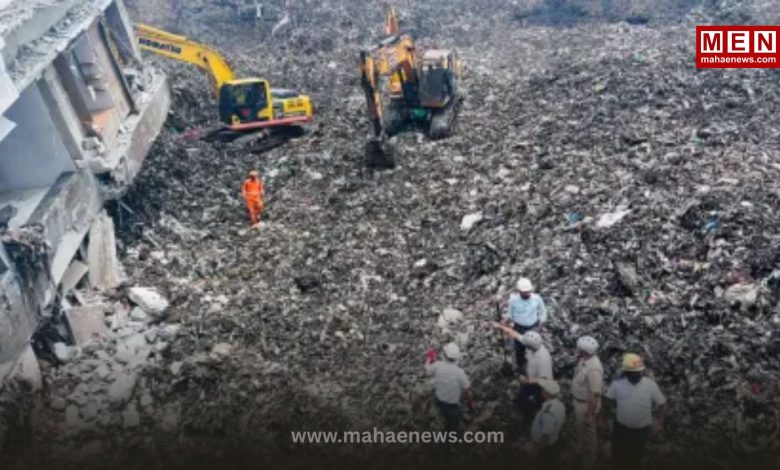
Pimpri-Chinchwad | Special Correspondent | The tragedy at the Moshi garbage depot has shaken not just Pimpri-Chinchwad, but the entire state. Amidst heavy rainfall, a massive section of the garbage heap collapsed onto the administrative building of the ‘Waste-to-Energy’ project, claiming the lives of employees working there. For hours, the NDRF, fire brigade, police, and various other agencies risked their lives to carry out rescue operations.
Follow MahaENews-X on: Follow MahaENews on Instagram
However, even while the rescue work was underway—and before any official inquiry into the incident had begun—leaders from various political parties started trading accusations. Notably, many of these statements revealed a lack of technical knowledge, incorrect references regarding the facts, and incomplete information about the relevant regulations.
A ‘Residential Building’ or the Project’s Admin Building?
Speaking in the Legislative Assembly, Shiv Sena (Uddhav Balasaheb Thackeray) MLA Bhaskar Jadhav stated, “A mountain of garbage collapsed onto a residential building near the garbage depot.” In reality, however, the building struck by the collapsing garbage was not a residential building at all; it was the administrative (admin) building of the ‘Waste-to-Energy’ project, where project staff were working. Many expressed surprise that such information was presented in a supreme democratic institution like the Legislative Assembly without verifying the facts.
Where exactly does the 20-meter or 25-meter height rule apply?
Bharatiya Janata Party (BJP) MLC Shrikant Bharatiya raised the question, “Why were garbage mounds taller than the 20-meter limit allowed to be created at the depot?” Along similar lines, NCP (Sharad Pawar faction) MP Dr. Amol Kolhe raised the question: “How did garbage mounds reach a height of 30 to 35 meters when the limit for landfilling is only 20 to 25 meters?”
However, there is no universal legal rule applicable nationwide that mandates a specific height limit of “20 or 25 meters” for garbage depots or sanitary landfills. The final height depends on factors such as the landfill’s design, height, slope, stability, soil characteristics, geotechnical studies, environmental clearances, and local conditions. Experts state that it is essential to study these technical aspects before making such claims. India’s existing Solid Waste Management Rules do not contain a clear, universally applicable rule stating that a garbage mound must not exceed a maximum height of 20 or 25 meters.
If the Waste-to-Energy project isn’t at the depot, where should it be?
Shiv Sena (Eknath Shinde faction) MP Shrirang Barne expressed the view that “constructing the project building within the garbage depot premises was wrong.” However, the fundamental objective of a Waste-to-Energy project is to process the city’s solid waste and generate electricity from it. Consequently, such projects—along with their administrative buildings—are typically located within the waste processing facility’s premises. This is the standard operating procedure for most such projects across the country. This raises questions about the extent to which this allegation aligns with technical realities. Notably, when the project was inaugurated in Pune, MP Shrirang Barne was present on the dais alongside Prime Minister Narendra Modi in his capacity as the city’s MP.
Protest or rescue operation?
Sulabha Ubale, Deputy Leader of the Shiv Sena (Eknath Shinde faction), staged a sit-in protest in the Municipal Commissioner’s office. She raised serious questions regarding the officials and elected representatives. Subsequently, they attempted to highlight their stance by circulating a video of a telephonic conversation with Deputy Chief Minister Eknath Shinde on social media.
However, in this conversation, Deputy Chief Minister Eknath Shinde clearly instructed, “Instead of protesting right now, go to the site and assist with rescue operations. Action will be taken against those responsible after an inquiry; but saving lives is more important at this moment.” This raised questions regarding the priority between taking a political stance and cooperating with the administration.
Prakash Ambedkar’s Sharp Criticism
Prakash Ambedkar, chief of the Vanchit Bahujan Aghadi, also launched a direct attack on the ruling BJP over this tragedy. He posted a strong reaction on social media, suggesting that “corporators should be buried under the garbage heaps.” Such political commentary, coming while the investigation into the causes of the tragedy is underway, is likely to further inflame the situation. It has become evident that experienced leaders are attempting to politicize a natural disaster.
Tragedy or Political Opportunity?
The issue concerning the Moshi garbage depot did not arise overnight. It involves multiple factors, including ‘legacy waste’ accumulated over decades, a growing population, the generation of thousands of metric tons of solid waste daily, processing capacities, bio-mining, ‘waste-to-energy’ projects, heavy rainfall, and geotechnical stability.
Drawing conclusions, spreading misinformation, or making claims lacking technical basis regarding such a complex issue—before an official inquiry is conducted—can mislead the public. The real need is to identify the precise causes of the tragedy, fix accountability, rectify flaws in safety systems, and implement effective measures to prevent such incidents in the future.
Unfortunately, following this tragedy, it appeared that many political leaders prioritized allegations over facts and publicity over a studied understanding of the situation.
Follow MahaENews-X on: Follow MahaENews on Instagram