
India, Australia Sign Landmark Uranium Supply Deal
04PM Narendra Modi and Australian PM Anthony Albanese strengthen strategic ties with a historic uranium agreement, defence roadmap, maritime cooperation, and major technology initiatives.
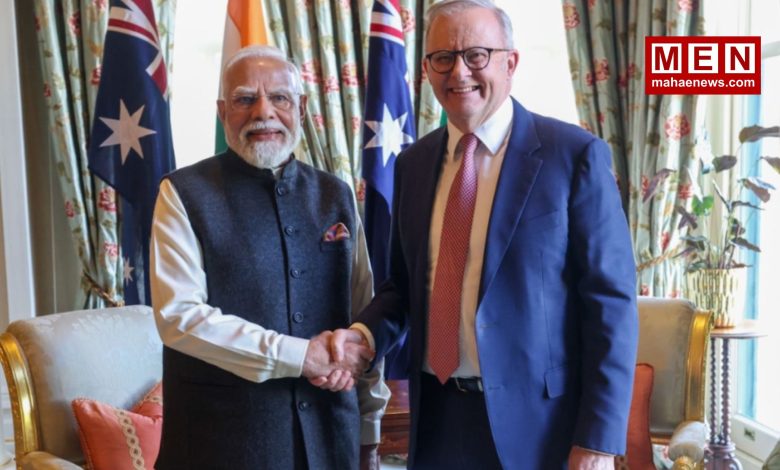
India and Australia Seal Historic Uranium Supply Agreement, Deepen Strategic Partnership
Melbourne: India and Australia have signed a landmark uranium supply agreement, marking a major milestone in bilateral relations during talks between Prime Minister Narendra Modi and Australian Prime Minister Anthony Albanese in Melbourne. The two leaders also announced a series of strategic initiatives covering defence, maritime security, energy, education, technology, and space cooperation.
Follow MahaENews-X on: Follow MahaENews on Instagram
The agreement is expected to significantly strengthen India’s clean energy ambitions while expanding the strategic partnership between the two Indo-Pacific nations.
Historic Uranium Deal to Boost India’s Energy Security
Under the agreement, Australia will provide a long-term supply of uranium to support India’s civilian nuclear energy programme.
The administrative arrangement has been signed under the 2015 India-Australia Civil Nuclear Cooperation Agreement, enabling India to diversify its energy sources and accelerate the production of clean, low-carbon electricity.
Australia possesses nearly one-third of the world’s known uranium reserves, making it a key long-term energy partner for India.
Australian Prime Minister Anthony Albanese said:
“India and Australia are not just partners but close friends. This agreement will take our cooperation in defence, education, science and technology to a new level.”
Strategic Move Amid Growing Indo-Pacific Tensions
The agreement comes shortly after China reportedly conducted a ballistic missile test in the Pacific region, highlighting the increasing strategic importance of the Indo-Pacific.
Prime Minister Modi reaffirmed that India and Australia remain committed to maintaining peace, stability, freedom of navigation, and a rules-based international order in the region.
Modi Uses Cricket Analogy to Describe Bilateral Relations
While addressing the media, Prime Minister Modi used a cricket analogy to explain the growing partnership between the two countries.
“Our bilateral agenda is as target-oriented as a One-Day match. Our speed in taking important decisions is like T20 cricket. And the friendship between India and Australia is like a Test match—long-lasting, patient, and built on trust.”
The remarks drew attention for blending diplomacy with one of the most popular sports shared by both nations.
New Defence and Maritime Security Roadmap
The two countries renewed their 2009 Defence Cooperation Framework and announced a new strategic roadmap that includes:
-
Stronger military coordination between the armed forces.
-
Launch of the India-Australia Defence Innovation Corridor to connect defence startups and technology companies.
-
Expanded cooperation in defence manufacturing, information sharing, and disaster response.
India’s Coast Guard and Australia’s Maritime Border Command also signed a Memorandum of Understanding (MoU) to strengthen:
-
Maritime border security.
-
Joint law enforcement.
-
Search and rescue operations.
-
Marine pollution response.
-
Capacity building and operational cooperation.
Australia to Support ISRO’s Gaganyaan Mission
Australia will support India’s ambitious Gaganyaan Human Spaceflight Mission by establishing a temporary space tracking terminal on the Cocos (Keeling) Islands.
Both countries also announced a new Australia-Canada-India trilateral partnership to expand cooperation in science, research, and emerging technologies.
Ancient Indian Artefacts to Return Home
Australia will return three priceless cultural artefacts originating from Tamil Nadu to India, including:
-
An 11th–12th century stone sculpture of Nandi.
-
An 11th-century metal Trishul featuring Goddess Bhadrakali.
-
A 12th-century stone idol of Lord Kartikeya.
The artefacts were housed at the National Gallery of Australia and the Art Gallery of New South Wales.
In a reciprocal cultural initiative, Australia has also agreed to unconditionally repatriate the remains of Indigenous Australians currently preserved at the Government Museum in Chennai.
Major Agreements Signed
1. Defence & Security Cooperation
-
Expanded defence industrial collaboration.
-
Greater defence innovation and startup partnerships.
-
Enhanced intelligence and information sharing.
-
Stronger disaster response coordination.
2. Maritime Security Roadmap
-
Improved maritime surveillance and law enforcement.
-
Greater naval and coast guard cooperation.
-
Joint search-and-rescue operations.
-
Marine pollution prevention initiatives.
3. Energy Security
-
Long-term uranium supply for India’s civilian nuclear programme.
-
Stable supply of coal, LNG, diesel, and other energy resources.
-
Diversification of India’s energy basket.
4. Civil Nuclear Cooperation
-
Long-term uranium exports from Australia.
-
Strengthened peaceful nuclear energy partnership.
-
Greater energy security through diversified fuel sources.
5. Education & Academic Cooperation
-
Approval for Victoria University to establish a campus in Gurugram.
-
Permission granted to Flinders University to open a campus in Bengaluru.
A New Chapter in India-Australia Relations
The comprehensive package of agreements reflects the rapidly expanding strategic partnership between India and Australia. From clean energy and defence cooperation to education, technology, maritime security, and cultural heritage, both countries have reaffirmed their commitment to building a stronger and more resilient partnership for the future.
Follow MahaENews-X on: Follow MahaENews on Instagram