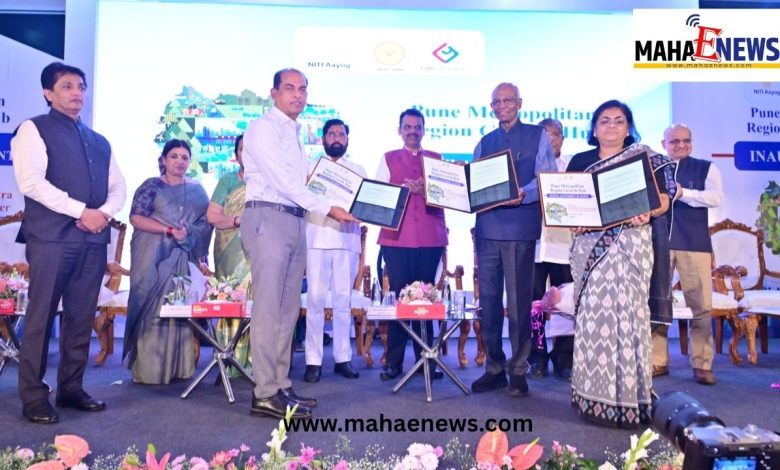
Inauguration of ‘Pune Metropolitan Region Growth Hub’ in the presence of Chief Minister Devendra Fadnavis
Pimpri-Chinchwad | The era where a single city could dominate a specific sector is now over, as multiple cities across Maharashtra are rapidly developing. However, Pune is a highly progressive city and a center of innovation, with the potential to enter new sectors and showcase its capabilities. In the future, Pune will surely soar, and the development plan being prepared through the Growth Hub will play a crucial role in that journey, said Chief Minister Devendra Fadnavis.
He was speaking at the inauguration of the ‘Pune Metropolitan Region Growth Hub’ organized at YASHADA, jointly by the NITI Aayog, Government of Maharashtra, and Pune International Centre. On this occasion, Deputy Chief Minister Eknath Shinde, Higher and Technical Education Minister Chandrakant Patil, Deputy Chairperson of the Legislative Council Dr. Neelam Gorhe, Minister of State for Urban Development Madhuri Misal, CEO of NITI Aayog B.V.R. Subrahmanyam, Padma Vibhushan Dr. Raghunath Mashelkar (Head of Pune International Centre), Additional Chief Secretary of the Planning Department Rajgopal Deora, and PMRDA Commissioner Dr. Yogesh Mhase were present.
Chief Minister Fadnavis stated that NITI Aayog will drive the Pune Metropolitan Region Growth Hub, the Government of Maharashtra and PMRDA will draft its blueprint, and Pune International Centre will assist in the process. If development is done in a planned manner, lifestyle ease can also be achieved. Today, 65% of the GDP comes from urban peripheries. This growth can be accelerated through proper planning. The creation of MIDC helped build a strong ecosystem, but an even more robust ecosystem could bring greater impact. Economic growth is the foundation for creating a good social environment, he added.
Focus on Developing Skilled Workforce for Industry
The Central Government has decided to allow foreign universities to set up campuses in India. Capitalizing on this opportunity, the state government has decided to create an ‘EduCity’ in Navi Mumbai through an organized approach. The government has provided infrastructure opportunities to unicorn startups. So far, 5 top global universities have signed MoUs, and a total of 10 are expected. In the next 4–5 years, around 50,000 students will study here. This will result in a GST revenue of ₹2,000 crore. More importantly, a large skilled workforce for industries will be created. These universities will usher in an AI-driven revolution, attracting global industries to the state, Fadnavis said.
Growth Hub Will Transform Pune’s Landscape
Pune is a production hub and is also considered the Oxford of the East. With excellent educational institutions, the city produces high-quality manpower. Where there is skilled manpower, large investments follow. This workforce is crucial for AI-based development. AI is now transforming every sector. Using this transformation, GDP growth can be further accelerated. If planning is done with a focus on the sectors Pune excels in, per capita income can be increased. The Growth Hub will include policies, policy changes, key sectors, their vision, core elements, and necessary infrastructure. A crucial document for the city’s future development will be created through this initiative, the Chief Minister stated.
The upcoming airport and ring road in Pune district alone are expected to positively impact the local economy by ₹3 lakh crore. Now, the goal is to not just compete with other cities, but with the world, to build a trillion-dollar economy. For this, barriers within the government system must be addressed. All departments need to participate, and a mindset shift toward policy execution is essential. We must also consider the harmful factors that make industries uncompetitive or discourage investors.
Proper Planning Essential for City Development – Eknath Shinde
Deputy Chief Minister Eknath Shinde noted that this day marks a new era in Pune’s development. The state aims to align Maharashtra’s progress with citizen-centric welfare initiatives. Pune’s journey will embody tradition, environment, progress, and pride. Under PM Modi’s leadership, the nation is working toward a $5 trillion economy. Meticulous planning is essential for economic growth and city development. NITI Aayog is assisting the state in this planning process, leveraging the capacities of the region through the Growth Hub model.
The central government has decided to initiate 14 growth hubs, including Mumbai and now Pune. Shinde emphasized that Pune leads in technology, industry, manufacturing, education, and healthcare and has significant tourism potential. Thus, the Growth Hub concept will surely succeed. Along with urban development, rural growth is also necessary. The benefits of city development through the Growth Hub will extend to rural areas. Road connectivity and infrastructure are vital for development. Due to the Mumbai-Pune Expressway, these two cities have effectively become twin cities. Pune is a hub for IT, EVs, semiconductors, and AI industries. With its educational institutions, Pune can become India’s center for skilled manpower. The Pune Metropolitan Region Growth Hub will elevate the region to international status, he asserted.
Growth Hub Concept Overview – by B.V.R. Subrahmanyam
Mr. Subrahmanyam presented the concept of the Growth Hub, stating that to transition India’s economy from the current $3 trillion to $5 trillion, planned urban development is vital. The Growth Hub initiative began with MMR (Mumbai Metropolitan Region), Surat, Varanasi, and Visakhapatnam. Now, Pune Metropolitan Region has also been included. The initiative focuses on accelerating regional economies, improving living standards, and promoting sustainable practices. A well-coordinated economic master plan aligned with India@2047 will be the first of its kind in the country.
Vision for Pune’s Economic Growth
Through the Growth Hub, Mumbai’s economy is planned to double from $140 billion to $300 billion within five years. Pune’s current economy of $58 billion is also set to double. A blueprint will be prepared in the next 4–5 months. Pune has the potential to become a production hub, with strengths in the automotive industry, IT, engineering R&D, education, agri-based industries, and MSMEs. Pune’s growth rate should be pushed to 10%, aiming to grow the economy to $600 billion. The vision is for Pune to emerge as a global leading city, he said.
Future Expansion Across Maharashtra – by Rajgopal Deora
In his introductory remarks, Mr. Deora stated that after the MMR Growth Hub, Pune’s initiative is the second such project. In later phases, Growth Hubs will be launched in Nagpur, Chhatrapati Sambhajinagar (Aurangabad), and Nashik. A total of five growth hubs will be established in Maharashtra. Pune, with its extensive educational facilities and skilled workforce, will drive export growth. Local institutions, industries, and organizations will be involved in the planning process. A formal MoU is being signed with Pune International Centre for the same, he added.
During the event, a memorandum of understanding (MoU) was signed between the Government of Maharashtra, NITI Aayog, and Pune International Centre for the Pune Metropolitan Region Growth Hub initiative.
Present at the event were MLAs Yogesh Tilekar, Bhimrao Tapkir, Rahul Kul, Divisional Commissioner Dr. Chandrakant Pulkundwar, PMC Commissioner Naval Kishore Ram, PMRDA Additional Commissioner Deepak Singla, Collector Jitendra Dudi, Zilla Parishad CEO Gajanan Patil, and dignitaries from industry, PMRDA officers, and staff.
About the ‘Developing City Regions as Growth Hubs’ Initiative
In 2023, NITI Aayog launched the ‘Developing City Regions as Growth Hubs’ initiative to transform urban areas into engines of dynamic growth. Initially implemented in MMR, Surat, Varanasi, and Visakhapatnam, Pune Metropolitan Region has now been added.
The main objectives are to promote economic dynamism, improve quality of life, and encourage sustainable practices. The initiative aims to align economic master plans with India@2047, and will serve as the first integrated, future-oriented urban blueprint in the country.